
America is drowning in oil. We pump 13.7 million barrels per day—more than Saudi Arabia or Russia. We’re energy independent, right? Wrong. The truth is far uglier: we’re exporting the oil we produce and importing the oil we actually need, all while praying the Middle East doesn’t sneeze. And right now, it’s sneezing all over your bank account.
The Strait of Hormuz blockade didn’t just spike oil prices—it exposed a $100 billion infrastructure flaw in America’s energy backbone. A flaw that’s about to make your life a lot more expensive.
The Refining Mismatch: America’s $100 Billion Mistake
Here’s the problem: not all oil is created equal. The shale boom flooded the U.S. with light sweet crude—low-density, low-sulfur oil that’s easy to extract but useless to most American refineries. Why? Because 70% of U.S. refining capacity was built to process heavy sour crude—the thick, sulfur-laden sludge that comes from Venezuela, Mexico, and the Persian Gulf.
Think of it like trying to run a diesel engine on premium unleaded. It won’t work. And right now, America’s refineries are starving for the heavy stuff—even as we ship 4 million barrels per day of our own light oil overseas to countries that can actually use it.
America’s refineries are like a steakhouse forced to serve tofu. They’re built for a specific menu, and right now, the kitchen is on fire.

The Hormuz Blockade: A Geopolitical Heart Attack for U.S. Refineries
The Strait of Hormuz handles 20% of global oil supply—mostly heavy sour crude. When it slammed shut in February 2026, the market didn’t just lose oil. It lost the specific kind of oil America’s refineries depend on. OPEC production plunged by 7.3 million barrels per day in March alone. Iraq’s output collapsed by 66%. Saudi Arabia, drowning in unsellable crude, slashed production by 2 million barrels per day.
The result? Brent crude surged to $115/barrel—a 77% spike in three months—while WTI, America’s light sweet benchmark, traded at a $3 premium to Brent for the first time since 2009. That’s not a price spike. That’s a market screaming in pain.
The Inflation Tsunami: Why Your Groceries Just Got 10% More Expensive
Here’s where it gets personal. Refineries don’t eat the cost of this chaos—they pass it on. And the first domino to fall? Diesel. The fuel that powers 18-wheelers, tractors, and cargo ships just spiked 45% in 30 days. That’s not a blip. That’s a supply chain earthquake.
Trucking companies, already operating on razor-thin margins, are reporting $10K–$20K weekly fuel cost swings. Small operators are going bankrupt. The survivors are slapping on fuel surcharges: 20–34% at FedEx and UPS, 8% at USPS, 3.5% on every Amazon seller. And who pays? You do—at the checkout line.
Diesel is the invisible tax on everything. When it spikes, inflation isn’t coming—it’s already in your cart.
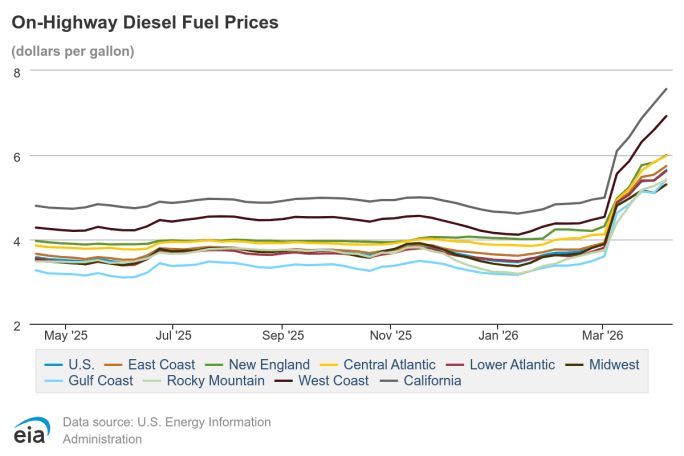
The Food and Drink Federation just revised its 2026 food inflation forecast from 3% to 9–10%. Why? Because 40% of a trucking company’s costs are fuel, and refrigerated trucks (the ones that deliver your milk, meat, and produce) guzzle even more diesel. Airlines are next: United projects $1.2B in extra fuel costs this year, and Delta’s already eaten $400M in Q1 alone. Expect 20% higher ticket prices by summer.
Goldman Sachs estimates this oil shock will add 0.5% to core PCE inflation and kill 10,000 jobs per month through 2026. The Fed? They’re trapped. Cut rates, and inflation roars back. Do nothing, and the economy slows under the weight of $6/gallon gas in California.